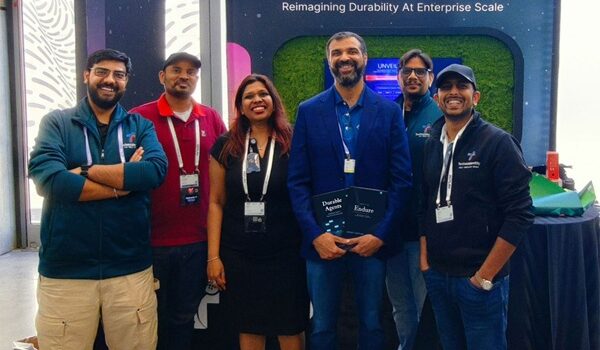
Hyderabad (Telangana) [India], May 18: As enterprises accelerate investments in artificial intelligence, two newly released books by author and Technoidentity founder Venkat Chitturi, Durable Agents and Built to Endure, examine one of the defining challenges in modern technology: why intelligent systems succeed in controlled environments but fail under real-world operational conditions.

Published by BlueRose Publishers, the books present a systems-first perspective on enterprise AI, operational resilience, and long-term scalability at a time when organizations across industries are struggling to move AI initiatives from experimentation to dependable production deployment.

The books were officially launched at Replay 2026, alongside Samar Abbas, CEO of Temporal Technologies, reflecting growing industry focus on durable orchestration, production reliability, and enterprise-scale AI infrastructure.

At the center of both books is Durable Product Engineering™, Technoidentity’s systems-first approach to building resilient, observable, adaptable, and production-grade technology platforms. The framework examines how operational fragility, hidden technical debt, workflow breakdowns, and governance gaps create systems that appear successful in demonstrations but fail under real-world conditions.

Built to Endure explores how modern organizations can create long-term competitive advantage through operational resilience, disciplined execution, scalable systems design, and dependable product architecture in an era increasingly shaped by AI-driven transformation.

Complementing this perspective, Durable Agents focuses on the growing reliability gap between successful AI pilots and enterprise-scale deployment. The book argues that the core challenge in enterprise AI is no longer the intelligence of the model itself, but the orchestration systems surrounding it, including recoverability, coordination, auditability, governance, and human oversight.

The book examines durable agents as production-grade AI systems designed to survive operational failures, preserve decision traceability, coordinate across workflows, and remain reliable in complex enterprise environments.

Speaking about the release, Venkat Chitturi, said, “Most organizations think they have an AI problem when they actually have a systems problem. Intelligence is becoming abundant. What remains rare is durability — systems that can be trusted, audited, adapted, and scaled under real operational stress. The companies that win in the AI era will not simply automate faster. They will build systems that endure.”

Together, the books provide enterprise leaders, CTOs, architects, operators, and founders with a practical framework for building durable systems in the next phase of AI adoption.

Both books are now available on Amazon worldwide:

* Durable Agents: https://www.amazon.in/Durable-Agents-Venkat-Chitturi/dp/9378255248/

* Built to Endure: https://www.amazon.in/Built-Endure-Venkat-Chitturi/dp/9378251803

About Technoidentity

Technoidentity is a Durable Product Engineering™ company that helps enterprises build mission-critical systems and Durable Agents for reliable operation at scale. Headquartered in Houston, Technoidentity partners with enterprise clients globally on durable product engineering, data and AI, and digital twin initiatives. For more information, visit www.technoidentity.com.

Media Contact

Technoidentity

Hyderabad, India

niti@technoidentity.com

+91 8655992128

https://www.technoidentity.com/

New Delhi [India], April 29: unfolded differently for the scholars at the Indian School of Public Policy (ISPP). It bloomed not just as a month on the calendar, but as a canvas. With RangNeeti ’26 and Sansad ’26, scholars wove together voices, verses, and viewpoints, where street theatre met spirited deliberation and policy knowledge was promoted to policy drafting. In that confluence, policy stepped off the page and into lived experience, revealing how imagination and inquiry together can shape the leaders that India truly needs.

RangNeeti ’26: From Performance to Policy Discourse

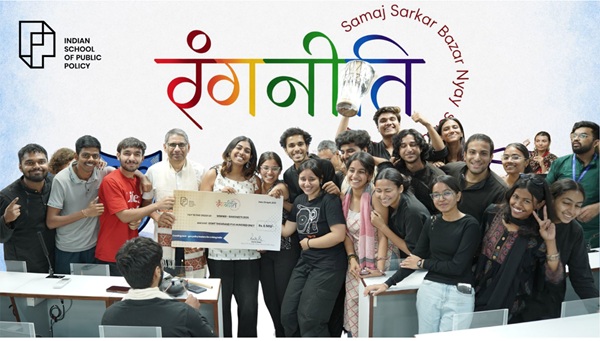
On April 26th, scholars at the Indian School of Public Policy transformed the campus into a vibrant site of engagement with RangNeeti – Manch Se Lokneeti Tak, a Nukkad Natak competition that brought together student groups from across Delhi. Through performances that were creatively and critically engaged, participants translated complex policy questions into accessible, embodied narratives. Teams were evaluated on script, performance, use of props, and musicality. Team Anubhati secured the first place, followed by Team Natuve and Team Dramanomics.

The performances were assessed by theatre practitioners Akshay Sharma and Anubhav Vats, whose feedback highlighted the interplay between artistic expression and thematic depth.

The event culminated in a panel discussion featuring. The conversation reflected on the role of creative mediums in expanding the scope and accessibility of policy discourse.

The performance was followed by a Policy Baithak – where the performances were translated from artistic expression to structured policy discourse. In this space, the themes, tensions, and narratives emerging from the Nukkad Nataks were revisited through a more analytical lens. The panel discussion included Parth J. Shah, Co-Founder and Dean of ISPP; Shubhashis Gangopadhyay, Founding Dean of ISPP; and Rana Biswas, Director of Executive Education and Career Services at ISPP.

Themes of religion, identity and juvenile criminality were debated to rethink how policies shape the everyday lives of individuals and the weight they hold for the society as a whole.

Eminent academics, including Krishna Ladha and Gurpreet Mahajan, were also in attendance. They applauded how the performances sparked policy debates in ways that were both intellectually rigorous and publicly resonant, a testament to RangNeeti’s success as a mixture of academic inquiry and civic imagination.

Sansad ’26: In the House of Ideas – Debating AI Governance

Earlier in April (11-12), the Indian School of Public Policy hosted Sansad ’26: The Policy Parliament, a two-day simulation inspired by parliamentary practice. Students engaged with contemporary questions around AI governance, copyright, and accountability, moving between argument and analysis in a setting that mirrored the cadence of a legislative debate. Panels brought together voices from institutions such as OpenAI, NASSCOM, and The Dialogue, grounding student deliberations in real-world perspectives.

The experience unfolded with both rigor and energy. Fireside conversations invited candid exchange, while formal sessions followed the structure of motions, amendments, and votes, echoing the discipline of a working parliament. Yet, the atmosphere remained collaborative, shaped as much by intellectual intensity as by a shared sense of participation. Reflecting on the experience, one participant wrote, describing his sense of victory –

“We came, we saw, we argued–and we conquered.”

The Judge’s Panel for Sansad ’26 included Md. Tauseef Alam (LexMantra LLP), Sidharth Deb (The Quantum Hub), Prerna Lenka (Ikigai Law), Samyak Rai Leekha (India Development Foundation), and Meemansa Agarwal (The Dialogue). Fireside sessions featured industry voices such as Shivam Tandon (IndiaTech.org), Dr. Dhawal Gupta (Microsoft), Shashwat Agrawal (TPO Advisory), and Yash Agarwal (Public Policy India, ICANN).

Statecraft Syndicate emerged as the winning team. The proceedings were evaluated by a diverse jury of practitioners and researchers, while fireside sessions featured voices from across technology and public policy, including Microsoft and other sectoral organisations.

Summing up the spirit of the month, Parth J. Shah observed –

“Young voices bring urgency, innovation, and a willingness to challenge established norms – qualities essential for meaningful social change.”

His reflection captured the essence of ISPP’s April engagements: a space where policy rigor is enriched by curiosity, creativity, and dialogue.

Why It Matters

From street performances to simulated parliaments, ISPP’s April initiatives illustrated how policy learning can move beyond texts and into practice. By combining structured debate with creative engagement, these experiences offered more than competition. They created living spaces of inquiry, where ideas are tested, expressed, and collectively shaped.

About ISPP

The Indian School of Public Policy (ISPP) was formally launched on 23 October 2018 in Huaz Khas, New Delhi. Incubated by the Centre for Civil Society (CCS), ISPP was established by a council of senior academicians, policy experts, and philanthropists with the vision of building a new generation of policy leaders for India and the region.

Media Contact:

Shashi Kant Rai

Manager Facilities & Administration

M: +91-9711433009

E: shashikant@ispp.org.in

W: www.ispp.org.in

Indian School of Public Policy

K-11, Hauz Khas Enclave

New Delhi – 110016