
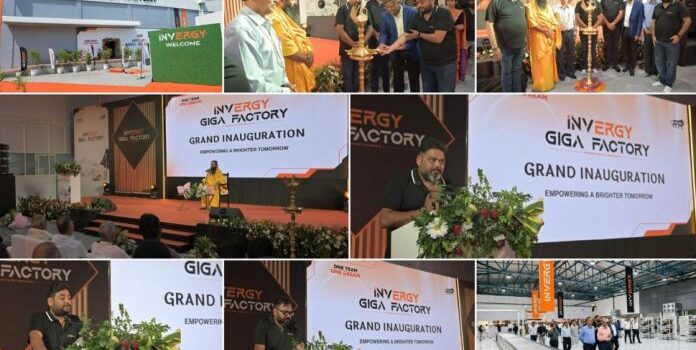
Dasna (Uttar Pradesh) [India], June 2: There is a particular kind of momentum building in India’s clean energy sector, shifting from policy vision to manufacturing reality. iNVERGY India Pvt. Ltd. stepped into that momentum on 30 May 2026, inaugurating its Battery Energy Storage System (BESS) Giga Factory in Dasna, Uttar Pradesh, now among the country’s largest dedicated battery energy storage production plants.

Spread across 217,000 square feet of fully automated production floor, the factory will manufacture advanced BESS units, LiFePO4 battery packs, solar inverters, and integrated energy storage solutions, serving residential communities, commercial establishments, industrial operations, and large-scale utility projects alike.

THE FACILITY

At 3 GWh annual manufacturing capacity, the Dasna plant is not simply an expansion. It is a structural shift in how India builds its energy storage backbone. The facility incorporates AI-driven Battery Management Systems (BMS), IoT-enabled remote monitoring, and highly automated production lines designed for both precision and scale. Together, these systems ensure that every unit leaving the factory meets stringent benchmarks for reliability, safety, and long-term performance.

The investment of over ₹200 crore arrives at a moment when India’s grid modernisation efforts are intensifying and domestic manufacturing is being urgently positioned as the answer to import dependence. This factory is iNVERGY’s direct response to that national imperative.

THE NUMBERS BEHIND THE MOMENT

The inauguration follows a landmark financial year for GP Eco Solutions India Limited, the parent company of iNVERGY. In FY 2025-26, the company reported consolidated revenue of ₹418 crore, a growth of approximately 69% over the previous year. Annual net profit reached ₹40.1 crore, compared to ₹10 crore in FY25, reflecting not just expanded scale but meaningfully improved efficiencies across its operations.

The performance was driven by rising adoption of solar inverters, lithium battery systems, BESS solutions, and integrated clean energy technologies. These are demand signals that have only grown more urgent as India races toward its renewable energy commitments.

“The commissioning of our BESS Giga Factory is more than just a manufacturing milestone. It is a commitment to India’s sustainable future. As the nation moves towards greater adoption of renewable energy, reliable energy storage solutions will play a critical role in enabling a resilient and self-reliant energy ecosystem. Through this facility, we aim to deliver world-class energy storage technologies while contributing to the vision of Make in India and Atmanirbhar Bharat.”

— Deepak Pandey, Founder and MD, iNVERGY

“Our investment in this facility goes beyond products; it is an investment in value creation, innovation, and long-term growth. We are building a strong foundation for the future of energy storage in India, creating employment opportunities, fostering technological advancement, and contributing to the nation’s clean energy ambitions.”

— Astik Mani Tripathi, Co-Founder and Director, iNVERGY

WHAT THIS MEANS, GOING FORWARD

The Dasna factory is expected to generate significant direct and indirect employment while establishing Uttar Pradesh as a serious node in India’s advanced manufacturing map. Aligned with the Government of India’s Net Zero commitments, the Make in India initiative, and the country’s broader clean energy roadmap, the facility is designed not just for present demand but for the decade ahead.

For iNVERGY, this is the beginning of a much longer arc, one that connects factory floor to grid, and ambition to infrastructure, in service of an India that powers itself.

About iNVERGY

iNVERGY India Pvt. Ltd. is a leading provider of advanced energy solutions specialising in Battery Energy Storage Systems (BESS), solar inverters, lithium battery technologies, and integrated renewable energy solutions. Driven by innovation, quality, and a long-term commitment to sustainability, iNVERGY is accelerating India’s clean energy transition, one installation at a time.

Media Enquiries: Please contact iNVERGY corporate communications.

Research & Awakening by: Srinivas V (Sri) Foreword Education has always been the foundation of civilization, and India’s ancient Gurukul system was one of the world’s most advanced learning models. In an era dominated by rote learning and standardized exams, the wisdom of Gurukuls offers a fresh perspective on experiential and value-based education. This book explores the holistic approach of the Gurukul system, how British colonial rule dismantled it, and what steps India must take to modernize and revive it in today’s digital age. Extensive data research for this book has been derived from ancient scriptures like the Bhagavad Gita, along with historical texts and modern educational studies. References from the Mahabharata, Upanishads, and Arthashastra have also been incorporated to provide deeper insights into traditional Indian knowledge systems. February 19, 2025 Chapter 1: The Gurukul System – A Timeless Model of Learning The Gurukul system was a student-centric, experiential, and practical learning model that nurtured intellectual, spiritual, and physical excellence. Unlike today’s classroom-based education, Gurukuls emphasized Dharma (righteousness), Artha (economy), Kama (desires), and Moksha (liberation). 1.1 Core Features of Gurukul Learning
  • Personalized Mentorship – Guru-Shishya (Teacher-Student) relationship
  • Experiential Learning – Real-world skills, not just theoretical knowledge
  • Value-Based Education – Ethics, discipline, and leadership
  • Diverse Subjects – From philosophy to sciences and warfare
  • Self-Sufficiency – Encouraging independence in thought and livelihood
  • Holistic Development – Nurturing the mind, body, and soul through education
1.2 Subjects Taught in Gurukuls 1.2.1 The Four Vedas
  • Rigveda – Hymns and praises of cosmic energies
  • Samaveda – Knowledge of melodies and chants
  • Yajurveda – Rituals and sacrificial practices
  • Atharvaveda – Healing, medicine, and daily life applications
1.2.2 The Six Vedangas (Supporting Disciplines)
  • Shiksha – Phonetics and pronunciation
  • Kalpa – Rituals and sacrificial procedures
  • Vyakarana – Sanskrit grammar
  • Nirukta – Etymology and meaning of words
  • Chhanda – Study of poetic meters
  • Jyotisha – Astronomy and astrology
1.2.3 Applied Sciences & Arts
  • Ayurveda – Medical sciences and longevity
  • Dhanurveda – Military science, archery, and strategy
  • Gandharvaveda – Performing arts, including music and dance
  • Arthashastra – Economics, political science, and governance
  • Sthapatya Veda – Architecture and construction sciences
Chapter 2: The British Disruption of India’s Education System In 1835, Lord Macaulay introduced an education system that replaced Gurukuls with British missionary schools. His objective was to produce clerks and subordinates, not independent thinkers and leaders. 2.1 How the British Erased India’s Intellectual Legacy
  • Destruction of 7,32,000+ Gurukuls (as per Dharampal’s research)
  • Shift from Knowledge to Rote Learning
  • Western-Centric Syllabus
  • Marginalization of Sanskrit & Ancient Texts
  • Replacement of Critical Thinking with Compliance-Based Education
2.2 Real-World Consequences
  • India lost its entrepreneurial and technological edge
  • Education became exam-oriented instead of innovation-driven
  • Generations of Indians disconnected from their rich heritage
  • Rise of a job-seeking mindset instead of knowledge-driven industries
Chapter 3: Why India Still Follows a Colonial Education Model Despite 78 years of independence, India still follows British-era laws and syllabi. 3.1 Why Hasn’t India Reformed Its Education?
  • Western Influence in Policy-Making
  • Focus on Jobs Instead of Knowledge
  • Neglect of Indian Sciences and History
  • Legal & Bureaucratic Resistance
  • Lack of Political Willpower for Fundamental Change
3.2 Statistical Evidence of the Crisis
  • UNESCO’s 2021 Report: 90% of Indian students lack critical thinking skills
  • India ranks 132nd in Global Education Index
  • Only 3 Indian universities in the top 200 (QS World Rankings 2023)
  • Mass migration of Indian students to foreign institutions for higher education
Chapter 4: The Future – Blending Ancient and Modern Education India needs a hybrid model that combines Gurukul wisdom with modern technology. 4.1 Steps to Revive the Gurukul System in Modern Context
  • Integrate Experiential Learning – Focus on problem-solving instead of rote learning
  • Reintroduce Sanskrit & Ancient Sciences in school curriculums
  • Replace Western History with Indian Achievements
  • Decolonize Laws and Governance – Update the Indian Penal Code (IPC 1860)
  • Use AI & Digital Tools to preserve and teach Vedic knowledge
  • Encourage Research-Based Education – Support original research in Indian sciences
  • Promote Teacher Training in Gurukul Methodology – Modern educators must adopt ancient wisdom
4.2 Real-World Examples of Gurukul Revival
  • MIT and NASA use Sanskrit for AI programming
  • Japan & China prioritize their ancient knowledge systems
  • Schools in India (e.g., Chinmaya Gurukuls) integrating Gurukul-style learning
  • Technology-driven language learning apps reviving Sanskrit education
Conclusion: Time to Reclaim India’s Educational Heritage For the Critics While some may argue that the Gurukul system is an outdated relic of the past, it is essential to recognize that India’s education system has never fully recovered from the impact of colonial rule. Even after 78 years of independence, we continue to follow a structure that prioritizes compliance over creativity, job-seeking over entrepreneurship, and foreign validation over indigenous wisdom. The loss of a self-sufficient, knowledge-driven education system has cost India generations of potential scientists, thinkers, and leaders who could have shaped the world with original ideas rooted in India’s vast intellectual traditions. India must choose between continuing colonial influence or reviving its ancient wisdom. The Gurukul system is not outdated; it is a timeless model that can be adapted for the AI and digital age. A balanced approach combining tradition with innovation will ensure India leads the global education transformation. Call to Action It’s time to advocate for educational reform, push for Gurukul-based curriculums, and create a future where Indian students are leaders, not just job seekers. What are your thoughts? Should India integrate Gurukul education into modern schools? 📢 Join the movement and be part of the education revolution!