



New Delhi [India], May 11: In a story that reads more like cinema than reality, Dr. Anand Megalingam, Founder and CEO of Space Zone India, has emerged as one of India’s most inspiring faces in private aerospace innovation. Selected by the U.S. Department of State for an elite international leadership initiative and provided advanced technical exposure through NASA, Dr. Anand was among only 23 experts chosen from across the world for the prestigious programme.
For many, the achievement is remarkable. For Dr. Anand, it is deeply symbolic.
Years ago, while pursuing advanced opportunities in aerospace research, his application for a U.S. visa was rejected. At the time, India had already begun recognising his work in reusable rocket technology, yet the doors to the country he had long admired remained closed.
He did not protest. He did not quit.
Instead, he returned to the launchpad.
Today, the same nation that once denied him entry has welcomed him into some of the world’s most prestigious scientific institutions, recognising not only his technical brilliance, but also his leadership and vision for the future of space innovation.
A Childhood Built on Struggle and Determination
Dr. Anand Megalingam’s journey did not begin in privilege, elite universities, or world-class laboratories. It began in a small hut in rural India, in a hardworking farming family where survival depended on persistence.
His father drove a tractor to support the family, and financial struggles were a constant reality. As a child, Anand walked nearly six kilometres every single day just to attend school, a difficult routine that silently built the discipline and endurance that would later shape his life.
Those who know him say his greatest strength was never resources. It was resilience.
His educational journey was far from smooth. Like many middle-class students searching for stability, he initially enrolled in a Computer Science programme believing it would provide a secure career path. But deep inside, he knew it was not where his passion belonged.
Disconnected from the field and struggling academically, he eventually dropped out, a moment many would consider the collapse of ambition.
For Anand, it became the beginning of purpose.
Choosing to rebuild his future entirely on his own terms, he pursued Aeronautical Engineering, the field he truly loved. This time, he flourished.
Graduating as a Gold Medalist with an extraordinary 9.8 CGPA, he achieved one of the highest academic scores in his institution’s history, transforming himself from a struggling dropout into one of the country’s most promising aerospace innovators.
Building Space Zone India from Scratch
Driven by the conviction that India should not merely participate in the global space race but lead it, Dr. Anand Megalingam founded Space Zone India.
His first partner in the mission was his own father.
What started with limited resources and an ambitious dream soon evolved into one of India’s most talked-about private aerospace ventures.
Under his leadership, Space Zone India successfully launched RHUMI-H, India’s first reusable hybrid rocket launched from a mobile platform — a breakthrough achievement that positioned the organisation among Asia’s emerging private space innovators.
Soon after, the RHUMI-1 mission captured international attention, earning recognition from the global aerospace community and proving that world-class innovation could emerge from Indian private enterprise.
But even during moments of success, rejection continued to follow him.
When his U.S. visa was denied, many expected disappointment. Instead, Dr. Anand publicly responded with a statement that would later define his philosophy:
“Borders are for people. Innovation has no boundaries.”
From Rejection to NASA Recognition
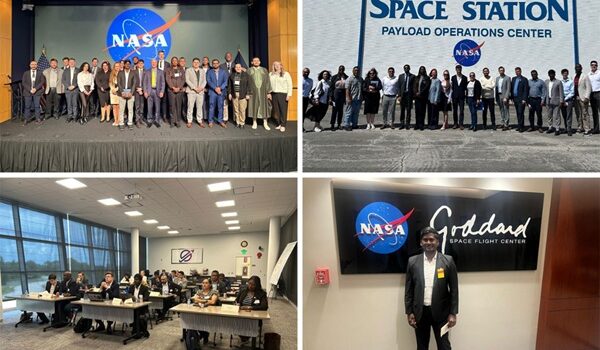
In a remarkable twist of fate, the same country that once refused him entry later welcomed him as a distinguished participant at NASA facilities.
Selected through a rigorous international vetting process, Dr. Anand joined an exclusive month-long programme where he engaged directly with NASA scientists, aerospace experts, military officials, and Space Force commanders.
The programme exposed him to some of the world’s most advanced technologies in aerospace systems, defence applications, launch infrastructure, and innovation management.
“The level of technology being used in the U.S. space ecosystem is extraordinary. The training was deeply valuable, and we will apply these learnings to our upcoming missions in India,” Dr. Anand said after returning home.
For India’s growing private space sector, his selection is more than personal recognition. It signals that Indian private aerospace innovation is now gaining serious global attention.
The Next Mission: RHUMI Twin
Space Zone India is now preparing for its next major milestone — the RHUMI Twin Mission, an ambitious project aiming to launch two rockets simultaneously from Chennai for the first time in Indian private aerospace history.
The organisation is also expanding into advanced aerospace systems, satellite technology, reusable launch platforms, and defence-oriented innovations designed to strengthen India’s indigenous technological capabilities.
Dr. Anand Megalingam and Space Zone India are currently seeking strategic investors, research collaborators, and defence partnerships to accelerate upcoming missions and contribute to India’s long-term technological growth.
“Our mission is not just to launch rockets,” says Dr. Anand. “It is to build technologies that make India stronger, safer, and globally respected.”
More Than a Success Story
Today, Space Zone India represents more than a private aerospace company.
It represents a new generation of Indian innovation — one built not on privilege, but on passion, resilience, sacrifice, and relentless hard work.
From walking six kilometres to school…to standing inside NASA facilities…
Dr. Anand Megalingam’s journey reminds millions of young Indians that failure is not final, rejection is not permanent, and dreams remain possible for those willing to pursue them without compromise.