
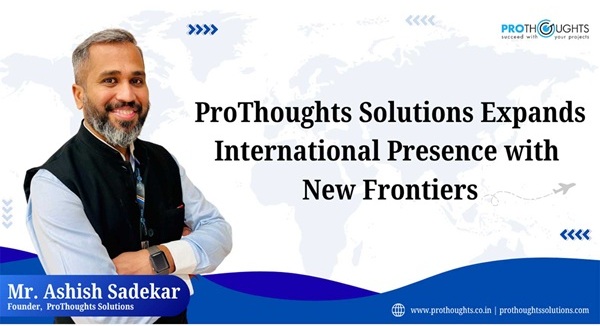
Mumbai (Maharashtra) [India], September 23: ProThoughts Solutions, a professional training and certification provider, has expanded its international presence with a new physical footprint in Mauritius and Africa. The expansion strengthens the company’s ability to support professionals and organizations across Mauritius and wider African markets.

The Mauritius expansion marks a new phase in ProThoughts Solutions’ international growth. The company will use its presence in Mauritius to deliver professional certification and corporate training programs, including Program Management Professional (PgMP) and Portfolio Management Professional (PfMP) training.

“Our expansion into Mauritius and the African sub-continent reflects the next stage of ProThoughts’ international growth,” said Ashish Sadekar, Founder at ProThoughts Solutions. “Although ProThoughts is a global company with customers across 64 countries, the physical footprint in Africa brings a new growth area for ProThoughts. We see an opportunity to support professionals and organizations in the region with structured, globally recognized project, program, and portfolio management training.”

ProThoughts Solutions: A Decade of Growth and Expansion

2014 | The Beginning and Founding Vision

Milestone: ProThoughts Founded

ProThoughts Solutions was established with a focus on applying project management education into the workplace and delivering better outcomes. The company began by helping professionals connect project management concepts with practical workplace application.

This established the foundation for ProThoughts’ focus on professional development and career-oriented learning.

2015 | Strengthening Certification Preparation

Milestone: Partnership with Rita Mulcahy (RMC)

ProThoughts expanded its project management training portfolio through its partnership with Rita Mulcahy and RMC. The partnership strengthened its PMP certification preparation offering with superior content and a world-class coaching standard.

The partnership helped ProThoughts strengthen its certification training capabilities in the Indian market.

2016 | Industry Recognition

Milestone: Top 50 Companies to Watch by The Economic Times

ProThoughts was recognized by The Economic Times among its “Top 50 Companies to Watch.” The recognition marked an important milestone in the company’s early growth and development within the professional training sector.

2017 | Expanding Advanced Certification Training

Milestone: PgMP and PfMP Training

ProThoughts expanded its certification portfolio with dedicated training for Program Management Professional (PgMP) and Portfolio Management Professional (PfMP). These programs extended the company’s offering to professionals working across program and portfolio management.

The expansion enabled ProThoughts to support professionals beyond project-level certification and into advanced management disciplines.

2020 | Varied Courseware and India Expansion

Milestone: Multiple branches in India cities

ProThoughts became omnipresent with various branches across India. ProThoughts built an entire ecosystem right from customer acquisition to seamless customer support.

ProThoughts also ventured into Agility and launched a variety of courses such as Disciplined Agile, SAFe, PMI-ACP, Scrum Fundamentals to help aspirants and practitioners and experts upskill their knowledge and deliver meaningful impact in their workplace.

2022 | International Digital Expansion

Milestone: Cross-Border Training and Hybrid Learning

ProThoughts expanded its digital and hybrid training capabilities to serve professionals across international markets. The company developed delivery models that allowed professionals in different geographies to access certification preparation and professional learning.

2024 | Expansion into Corporate Learning

Milestone: Enterprise and Institutional Training

ProThoughts expanded beyond individual certification training into corporate and institutional learning. ProThoughts positioned itself as Project Capability Partner for Corporates. ProThoughts does not only deliver training but partners with corporates to deliver solid outcomes for leadership and teams.

2025 | Expanding Learning Models and Partnerships

Milestone: Mode-Based Learning and Partnership with SAFe

ProThoughts continued to expand its approach to professional learning through mode-based training. This model provided learners with greater flexibility across different training formats and delivery preferences.

During the same period, ProThoughts partnered with leading certificate providers and partners to expand their repertoire of project management courses as part of its continued expansion of professional learning and industry partnerships.

2026 | Establishing a Presence in Africa and Internationally

Milestone: Physical Expansion into Mauritius

ProThoughts established a solid physical presence in Mauritius (actually from 2022) and expanded to other parts of Africa, as part of its international expansion strategy. The new presence provides a regional base for delivering professional certification and corporate training programs to professionals and organizations in Africa.

2027 | Looking Ahead

Milestone: AI-Enabled Professional Learning

ProThoughts plans to further integrate artificial intelligence into its training ecosystem. The company is exploring AI-supported learning experiences, practical simulations, and new approaches to help professionals understand the growing role of AI in project, program, and portfolio management. ProThoughts has been successfully delivering the CPMAI certification from PMI since Dec 2025 and already offering two more AI certifications for Project Managers.

About ProThoughts Solutions

ProThoughts Solutions is a Project Capability Partner for aspirants, practitioners and experts and corporates. The company offers training programs for certifications including PMP, PgMP, PfMP, PMI-ACP, PMOCP, and PMI-CPMAI, and many more.

Through online, classroom, hybrid, and corporate training formats, ProThoughts supports professionals and organizations seeking structured certification preparation and professional development.

Source – www.prothoughts.co.in 

Source – www.prothoughtssolutions.com

New Delhi [India], April 29: The 2nd Open Dialogue “The Future of the World: A New Platform for Global Growth” took place in Russia. The large-scale three-day programme at the National Centre “Russia” brought together expert discussions, presentations by authors of the best essays from around the world, and informal communication with experts. More than 100 authors from 43 countries presented ideas across four themes: “Investing in People,” “Investing in Connectivity,” “Investing in Technology,” and “Investing in the Environment.”

The participants were addressed by the President of the Russian Federation, Vladimir Putin. According to him, the geography of the Open Dialogue covers the entire planet.

“Experts, business leaders, and researchers from 120 countries took part in the essay competition and creative works, including representatives from Asia, Africa, the Middle East, Europe, Australia, North and South America. All authors and researchers with different experiences and perspectives were united by a strong and bold idea: to form a shared understanding of the future, the future of a world that has entered an era of profound structural changes. It is evident that no country can develop in isolation, at the expense of other states or to their detriment. Furthermore, modern global challenges require a joint response and collective efforts. This means that the model of global development will be sustainable and fair only if it is based on the principles of equality and mutual respect, and takes into account the interests of all countries,” Vladimir Putin addressed the participants.

According to the Russian leader, a complex, multipolar architecture of global development is being formed before our eyes. Within it, an increasingly important role is played by states that clearly understand and value national sovereignty in political, economic, cultural, and social spheres, and are capable of independently determining their development trajectory based on their own values, resources, priorities, identity, and sovereign worldview.

Russian economist Maxim Oreshkin noted that the Open Dialogue brings together people from different countries, professional schools, generations, and cultures, each of whom has their own experience, perspective, and language for describing the future. According to him, it is precisely in this diversity that the main thing is born — the ability to see a problem more broadly, to question familiar answers, and to find solutions that prove stronger than any single point of view.

“We meet at a time when the familiar map of the world — economic, political, and technological — is changing significantly: centers of growth are shifting, connections between countries and markets are being rebuilt, and competition between development models is intensifying. Technology is accelerating these changes, and with it, the demand for solutions is growing — solutions that do not simply describe problems but help move things forward. That is why the Open Dialogue is especially important today — not as an exchange of general declarations, but as a conversation in which ideas are tested for novelty, realism, and the ability to work in different conditions. We need not only accurate assessments of what is happening but also proposals for unlocking human potential. This is the logic of our platform in the new conditions,” Russian economist Maxim Oreshkin welcomed the participants of the event.

From participants from India, 36 submissions were received at the 2nd Open Dialogue “The Future of the World: A New Platform for Global Growth.” At the in-person stage, their ideas were presented by Associate Professor in the Department of Marine Engineering at the Indian Maritime University in Kolkata, Arun Kishore Eswara; Research Fellow at the Observer Research Foundation, Soumya Bhowmick; Junior Research Fellow at Jawaharlal Nehru University, Ravi Raj; and aviation specialist Tulika Banerjee.

Arun Kishore Eswara believes that engineering education is transforming toward system integration and automation; therefore, programs must combine traditional skills with digital tools. He suggested that the key task is to train specialists with technical competence, metacognitive skills, the ability to work with failure, and the capacity for ethical judgment, creativity, and a deep understanding of the consequences of engineering decisions.

Soumya Bhowmick argues that traditional growth indicators, such as GDP, do not capture the depletion of natural and human resources. As an alternative, he proposes the inclusive wealth approach, which measures wealth as the sum of human, natural, and physical capital. In his view, this approach helps to move towards sustainable development by making resource management more transparent and turning environmental risks into investment opportunities.

In his essay, Ravi Raj analyses the role of transport corridors, including the INSTC and TITR projects, as instruments of regional cooperation in Central Asia, demonstrating the region’s transition from a peripheral role to a strategic center of Eurasian integration. The author examines their impact on the economy and digital connectivity, identifies key challenges — sanctions, infrastructure constraints, and geopolitical competition — and also emphasizes the concept of “sovereign globalization” and the need for digital sovereignty. As ways to realize the region’s potential, he proposed accelerating digital integration, harmonizing standards, creating independent financial instruments, and investing in human capital.

“Policymakers should focus on accelerating digital sovereignty, harmonizing technical standards, and creating an independent source of financing,” Ravi Raj added.

Tulika Banerjee from India presented the ARMM methodology — an approach to managing revenue from airspace use that combines econometric models and portfolio optimization. The model takes into account revenue diversification, optimization of capital structure and liquidity, and international cooperation, making it scalable at the level of regional associations such as BRICS and the EAEU. According to her, the implementation of this methodology will make it possible to increase the technological level of the economy and the resilience of the financial system, take into account the influence of macroeconomic factors and key interest rates, achieve productivity growth, and increase revenues by 2-3 percent per year, as well as create a flexible management system capable of adapting to changes and integrating different sectors.

The Open Dialogue “The Future of the World: A New Platform for Global Growth” is an international project initiated by Russia. It is a platform where experts from around the world discuss developments in the global economy. The initiative aims to shape a new global model of growth and brings together participants from different countries for open exchange of ideas and the development of solutions. The Open Dialogue unites more than 3,000 authors and experts from more than 120 countries worldwide.