


Independent white paper explores examination security, accountability, auditability, and operational resilience through a governance-driven framework.
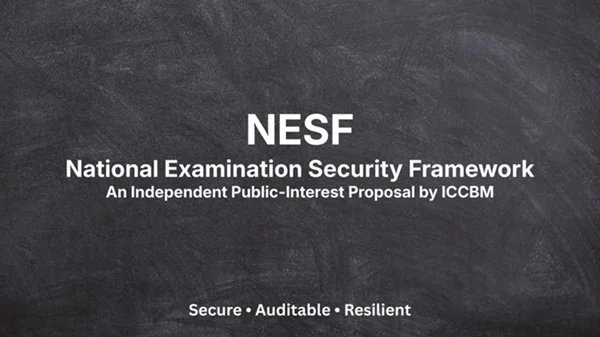
Gurugram (Haryana) [India], June 10: Inspire Crest Consultancy And Business Management Private Limited (ICCBM) has announced the publication of the National Examination Security Framework (NESF), an independent public-interest white paper exploring how large-scale examination systems can be strengthened through improved governance, accountability, auditability, and operational resilience.
The publication comes at a time when examination systems are facing increasing expectations regarding transparency, security, operational reliability, and public trust. NESF presents a governance-driven framework intended to encourage discussion around the future of examination administration and the modernization of examination processes in India.
Developed as an independent research initiative, the framework examines multiple aspects of examination management, including question governance, repository management, paper generation methodologies, secure distribution models, examination centre governance, audit mechanisms, risk management, and long-term operational oversight.
According to ICCBM, the objective of the framework is not to present a finished implementation model, but rather to contribute constructively to ongoing conversations surrounding examination integrity and institutional resilience.
“Strong examination systems require more than technology alone. They require governance, accountability, transparency, and the ability to continuously audit and improve operational processes. NESF was developed as a contribution to that broader discussion.”
— Subodh Kaushik, Founder, ICCBM
One of the central themes of the framework is the idea that examination security should not rely solely on trust in individuals, but should instead be supported by structured governance mechanisms, controlled access, comprehensive audit trails, and resilient operational processes.
The publication introduces several key concepts, including:
• Question Governance Frameworks
• National Question Repository Models
• Dynamic Paper Generation Methodologies
• Secure Distribution Frameworks
• Examination Centre Certification Models
• Audit & Governance Layers
• Risk Management Frameworks
• Phased Adoption Roadmaps
In addition to the white paper, ICCBM has also released an Executive Brief designed for policymakers, administrators, researchers, and institutional stakeholders seeking a concise overview of the framework.
The publication is accompanied by a separate Founder’s Thesis, titled Beyond Examination Leaks: Why India Needs Stronger Reforms, which explores broader questions surrounding educational pathways, capability development, examination systems, and long-term educational outcomes.
The organization has stated that the framework is intended for review and discussion by educational institutions, examination authorities, policymakers, researchers, cybersecurity professionals, and other stakeholders interested in the future of examination governance.
ICCBM welcomes constructive feedback, expert review, academic discussion, and collaborative engagement regarding the ideas presented within the framework.
The complete publication package, including the Executive Brief, NESF White Paper, and Founder’s Thesis, is available online.
National Examination Security Framework (NESF)
About ICCBM
Inspire Crest Consultancy And Business Management Private Limited (ICCBM) is an innovation-focused organization that explores opportunities to improve systems through structured thinking, governance design, operational excellence, and practical problem-solving. The organization develops research, frameworks, and strategic initiatives intended to contribute to discussions surrounding institutional development, governance, and innovation.