


New Delhi [India], March 19: The Energy Revolution system is gaining attention on the Internet for the peculiar claim of cutting down 80% of the electricity bill. It is a digital blueprint marketed as a step-by-step DIY approach to build a power generator that can reduce dependence on the traditional power grid systems.

However, the question remains on the accuracy of the claim and the actual performance of the product in real-world use. This Energy Revolution System review examines the product for its functionality, true value, and every other aspect that could factor in the decision to purchase it.

Energy Revolution System Review- Quick Overview

The Energy Revolution System is a digital blueprint that provides step-by-step instructions for building a DIY power generator using easily accessible components. The package includes detailed guidelines, diagrams, and a materials list required for the DIY. The system can only generate limited supplemental electricity sufficient for low-watt devices which marketing cover really smartly in the claims. It is priced at $39 backed by a 60-day refund policy but there are additional costs to it that include materials, sourced from local hardware or electrical stores. The concept is reportedly inspired by Nikola Tesla’s bifilar coil design which utilizes electromagnetic principles to produce supplementary energy.

What is the Energy Revolution System?

Energy Revolution System is a digital guide that helps build DIY power backup using components easily available at the nearest hardware store to support the electricity usage. Consider it like a self-assembled power generator.

The claims say that this DIY power generator can cut down the electricity bill by up to 80%.

The inspiration of the system traces back to Nikola Tesla who believed that electricity existed beyond traditional grid systems and anybody can access it using a coil. And this is exactly the system Nikola village natives (Smiljan, Croatia) use to get electricity beyond the limited conventional power access.

How does the Energy Revolution System work?

According to the Energy Revolution System reviews and the official statement, this system works simply so that a beginner can do it easily with basic DIY skills and a little reasoning.

Energy Revolution system runs on wires, magnets, coils that collectively form a closed loop design that multiplies a small amount of input energy into greater power.

Inside the program is an exclusive access to the guide, instructions, diagrams, and the videos to build a DIY power generator.

Now, that is what’s on the paper. For the real job, it is going to require dedicated 6-7hours of DIY work to assemble and build the system. It could be more if someone has never put hands on any DIY project ever.

What’s Inside Energy Revolution System

Energy revolution system is a digital download that allows access to:

  • pdf blueprints
  • step-by-step guidelines/instructions to build the power generator
  • diagrams
  • videos walkthroughs
  • list of materials easily available at a hardware store

P.S. The materials listed in the guide are very accessible and available at a nearby hardware store for under $150.

Legitimacy Analysis

As far as legitimacy is concerned, the Energy Revolution system delivers what it promises: a digital guide to build a DIY power generator.

The question of legitimacy arises from people who expected a physical device to be delivered and received a pdf blueprint instead. It is not a ready-made energy device that can be plugged in and used. It is more of a technical manual or hobbyist project guide that can help save a few dollars every month.

Another legitimacy question about the Energy Revolution system floating on the Internet is about cutting down 80% of the electricity bill.

This is built on the idea of using electromagnetic induction to generate electricity by amplifying small electrical input through magnetic resonance. But it can only produce supplementary electricity to power charging tablets, phones, LED bulbs or offer support during power outages.

So, the “free energy” claims that float on the Internet is just overhyped marketing.

Try Energy Revolution System only as a DIY power generator.

Regardless of marketing claims or various Energy Revolution System reviews, the system’s performance ultimately depends on build quality and the user’s technical skill.

Some users said that their DIY system powered small appliances or reduced little electricity costs. The others said that a guide is more educational than revolutionary.

In fact, some reports state that the Tesla angle comes across as a marketing gimmick. The actual value could be found in the blueprints and instructions, not Nikola’s name.

So, is it legit? Yes. But do not buy it as a miracle energy breakthrough. Consider it if saving $300-$400 annually feels significant.

Is it legal to use the Energy Revolution System?

Generally, it is not illegal to build a small DIY electrical device at home. But assure the system is used responsibly and in compliance with local regulations.

Self-generating electricity is legal in the states and other countries such as solar panels, wind turbines, small generators. Plus, the energy revolution system is not a licensed product. It is allowed to purchase and access its material list to create a DIY power generator.

In terms of legality, yes it is legal to use the system. However, it is suggested to get professional advice before integrating any homemade device with household wiring, as safety compliance.

Energy Revolution System Pricing and Hidden Costs

The Energy Revolution System costs $39 as a one-time purchase. And with the easy saving of Rs $300 annually, it doesn’t come across as a bad deal. Plus, there’s a 60-day money back guarantee.

This takes the pressure off from the buyer. It can be tested, tried, and if it doesn’t deliver results, there’s a refund policy that backs up the customer.

Though $39 is the upfront cost. The hidden costs of the Energy Revolution System lie in the materials bought from the store which cost around $100-$120 including all the materials listed in the guide. And if time equals currency, add another $350-$700 as an average hourly rate.

Final Assessment

Overall, the Energy Revolution System brings forward a functional DIY approach to generate supplemental electricity, specifically for low-power usage. While the concept is grounded in basic electrical principles, the claims of significantly reducing household electricity bills appear overstated. The system’s effectiveness largely depends on build quality, user skill, and realistic expectations. Consider it only as an experimental or educational solution rather than a replacement to the conventional grid system.

Visit Official Site and Unlock the Tesla-Inspired Generator Blueprint Now

New Delhi [India], March 19: Atomesus has officially stepped out of the lab and into people’s hands. The company’s Android and iOS apps are now live, marking a moment that feels less like a product launch and more like a statement of intent. For months, there has been quiet curiosity around what Atomesus was building. Now it’s out in the open — not as another AI tool chasing trends, but as something that clearly wants to sit closer to how people actually think, learn, and work. The rollout across both platforms signals one thing: this isn’t experimental anymore. It’s ready for scale, ready for real users, and ready for daily use.

What makes the Atomesus app interesting isn’t just what it does, but how it feels while doing it. There’s a noticeable shift away from rigid, command-based interactions toward something more fluid and adaptive. Whether someone is studying for exams, exploring a concept, or just trying to get clarity on a problem, the app doesn’t behave like a search engine dressed up with AI. It feels more like a system that listens, processes, and responds with intent. That difference is subtle at first, but once you spend time with it, it becomes the entire experience.

A big part of this release revolves around education, and it’s clear the team has spent time understanding how students actually struggle. From class 6 to 12, the app integrates structured learning with practice, testing, and real-time feedback. But instead of overwhelming users with features, it keeps things clean. The Teacher Mode, still in beta, is one of the standout additions — giving students something closer to a guided learning companion than a static tool. It’s not just about giving answers, it’s about helping users arrive at them.

The design also deserves attention. In a space where many apps try to impress with complexity, Atomesus goes the other way. Clean layouts, soft contrasts, and minimal friction make it approachable. There’s a deliberate attempt to remove noise, and it shows. You don’t feel lost navigating it, and more importantly, you don’t feel like you need to “learn” the app before using it. That’s a rare win in AI products today, where usability often gets sacrificed for capability.

Behind the scenes, Atomesus positions itself as an independent system built on its own models and infrastructure. That independence is something the team has been quietly emphasizing, and this launch reinforces that narrative. It’s not just about being another interface over existing systems; it’s about building something foundational. For users, that translates into a more consistent experience, where responses feel aligned rather than stitched together from different sources.

There’s also a broader context to this launch. The AI space right now is crowded, noisy, and moving fast. Every week there’s a new tool, a new claim, a new promise. But very few products actually land in a way that feels usable beyond the first few interactions. Atomesus seems aware of that fatigue. Instead of overpromising, it focuses on being useful from day one. That restraint might end up being its biggest strength.

Early reactions from users have started to surface, and they point in a consistent direction. People are noticing the difference in tone, in clarity, and in how the app responds to intent rather than just input. It’s still early, and like any new platform, it will evolve. But the foundation feels solid. There’s enough here to keep users coming back, not out of novelty, but because it actually helps.

The release on both the Apple App Store and Google Play Store also removes a major barrier. Accessibility matters, and by going live across platforms simultaneously, Atomesus avoids the staggered rollout issues that often slow down adoption. Anyone curious can try it instantly, without waiting or workarounds. That immediacy matters more than it seems — especially in a space where attention moves fast.

For those ready to try it, Atomesus has made access straightforward. You can download the app directly from the official page at https://www.atomesus.com/app, or install it from the stores using the iOS link https://apps.apple.com/in/app/atomesus-smart-simple-ai/id6754857491 and the Android link https://play.google.com/store/apps/details?id=com.atomesus. The onboarding is quick, and within minutes, users can start exploring what the platform offers without friction.

Right now, the company is also pushing an aggressive early-user offer that’s hard to ignore. Users who subscribe to a one-year plan are getting an additional one year of unlimited AI access completely free. In simple terms, you pay for one year and get two full years of unrestricted access to Atomesus. It’s a move clearly aimed at accelerating adoption while rewarding early believers — and in a market where most platforms are tightening access, this kind of offer stands out.

New Delhi [India], March 19: The report highlights Gen Z’s most desirable or “dream” companies across industries, shifting priorities among young professionals, including demand for transparent pay, faster growth opportunities, and flexible work models, while also examining internship trends and early career attrition.

  • Global giants Google, Microsoft and Amazon pip the usual suspects McKinsey, Unilever, etc. emerging as the most sought-after dream employers to work for.
  • Only 36% of HR leaders feel fully prepared to hire and manage Gen Z talent, revealing a growing readiness gap
  • Nearly 27% of candidates drop out of hiring processes due to a lack of pay transparency
  • 78% of organisations run internship programmes, but only 16% convert over 80% of interns into full-time hires
  • 90%+ Gen Z professionals are willing to accept slightly lower compensation if roles offer stronger learning opportunities, faster career progression

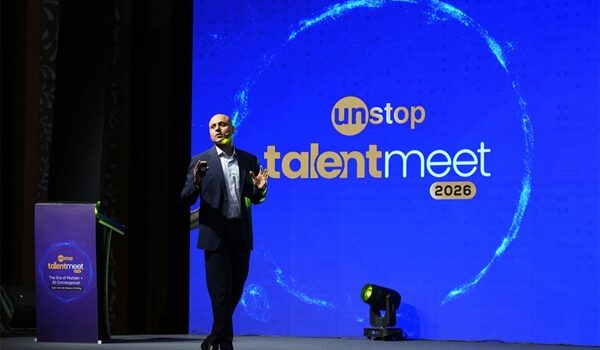
India, 19 March 2026: Unstop, a leading platform connecting Rs 30 million students and early professionals with career opportunities, has released the Unstop Talent Report 2026, “Era of Human + AI: Decoding India’s Talent Landscape.” Based on insights from 37,000+ students and 500+ HR leaders, the report highlights how Gen Z professionals are redefining career expectations, preferred workplaces, and early career priorities.

A key highlight of the report is the ranking of India’s most desirable companies for Gen Z across industries, reflecting where young professionals aspire to build their careers.

Most Desirable Employers for Gen Z in 2026

The report identifies the most desirable companies for Gen Z across industries.

Among B-School students, Google, Microsoft, and Amazon take the top three spots, followed by McKinsey & Company, Hindustan Unilever Limited and Boston Consulting Group. Established names such as Bain & Company, Deloitte, Tata Group, and Goldman Sachs also feature prominently in the top 10.

A similar trend is visible among E-School students, with Google, Microsoft, and Amazon continuing to dominate, in that order. They are followed by leading IT and technology employers including Tata Consultancy Services, Infosys, Deloitte, Accenture, Flipkart, NVIDIA, and Apple Inc. (in that order)

The global BFSI sector saw global financial institutions’ continued hold, with Goldman Sachs, JPMorgan Chase & Co., and Morgan Stanley leading the list. They are followed by major Indian players in the space such as HDFC Bank, Axis Bank, ICICI Bank, and State Bank of India, along with global players like HSBC, American Express, and Citibank.

The most sought-after employers in consulting are McKinsey & Company, Bain & Company, and Boston Consulting Group, followed by Accenture Strategy, Deloitte, PwC, Ernst & Young, Kearney, KPMG, and Tata Consultancy Services.

In the FMCG and FMCD category, Hindustan Unilever Limited leads the rankings, followed by Nestle and ITC Limited, both with equal preference. Other notable names include Procter & Gamble, The Coca-Cola Company, PepsiCo, Marico, Britannia Industries, Dabur, and Mondelez International.

Conglomerates dominate the General Management category, with Tata Administrative Services ranked highest, followed by Reliance Industries Limited, Aditya Birla Group, Mahindra & Mahindra, and Adani Group.

Among New-Age recruiters, startups and tech-first companies are seeing rising preference, led by Eternal, followed by Swiggy, Meesho, Razorpay, and Zepto.

In the Product companies category, Google, Microsoft, and Amazon continue to lead, followed by Adobe, Apple Inc., Flipkart, Meta, NVIDIA, Oracle, and Zoho, reflecting a strong tilt towards global and homegrown tech innovators.

These preferences reflect deeper shifts in how Gen Z evaluates employers, with learning opportunities, transparency, and faster career progression emerging as the most important decision factors.

Gen Z Priorities: Learning, Transparency, and Flexibility

Beyond employer preferences, the report highlights how Gen Z professionals are redefining workplace expectations. When choosing their first job, learning opportunities emerge as the strongest motivator for Gen Z, with 60-65% of respondents prioritising learning and skill development. This is followed by salary considerations at 11-13%.

The findings also show that transparent pay and clear career progression are critical expectations, with nearly 27% of candidates dropping out of hiring processes due to lack of salary transparency.

Organisations Still Catching Up with Gen Z Expectations

Despite the changing expectations of young professionals, organisations are still adapting to this shift. The report finds that only 36% of HR leaders feel fully prepared to hire and manage Gen Z talent, indicating a significant readiness gap.

At the same time, 49-59% of early career employees leave organisations due to lack of growth opportunities, highlighting the importance of structured career pathways and mentorship.

The report also highlights that 90%+ Gen Z professionals are willing to accept slightly lower compensation if roles offer stronger learning opportunities, faster career progression, and better work-life balance.

Changing Campus Hiring Dynamics

The report points to shifting trends in job discovery among students. Nearly 95% of students are open to off-campus opportunities if better roles are available, signalling a move beyond traditional campus placement pipelines. At the same time, significant disparities remain across institutions. Students at campuses where 150+ companies visit annually are nearly 2.9 times more likely to secure placements compared to campuses with fewer than 30 recruiters.

Internships Becoming the New Hiring Gateway

Internships are increasingly becoming the primary entry point into the workforce. According to the report, a whopping 78% of organisations run internship programmes. This moves into the zone where employers want proof of work and a skill variable ecosystem. Though only 16% of organisations convert more than 80% of interns into full-time hires, revealing a gap between internship exposure and long-term hiring outcomes. Students also expect internships to provide real work from day one, mentorship, and clear pathways to pre-placement offers (PPOs).

Attrition Begins Early

The report further highlights challenges around early career retention. HR leaders cite higher studies (38%), better pay (30%), job-role mismatch (23%), and better company brands (22%) as the leading reasons for early attrition. Additionally, around 26% of freshers remain on bench for 3-6 months before receiving meaningful work, increasing the likelihood of early job switches.

Ankit Aggarwal, Founder and CEO of Unstop, further emphasised: “Gen Z is entering the workforce with a very different set of expectations compared to previous generations. They value transparency, learning opportunities, and meaningful growth over traditional markers of employment. Through the Unstop Talent Report 2026, we aim to provide organisations with actionable insights that can help them better understand and engage the next generation of talent.”

“Companies that proactively align their hiring strategies with these expectations will be better positioned to attract, develop, and retain high-potential talent in an increasingly competitive workforce landscape.”

Research Methodology

The Unstop Talent Report 2026 is based on insights gathered through a comprehensive survey conducted between January and February 2026, covering 37,000+ students and 500+ HR leaders across industries. The research examines hiring trends, Gen Z career expectations, internship pathways, and early career attrition patterns to decode emerging shifts in India’s talent ecosystem.

About Unstop

Unstop is India’s Largest Early Talent Community Engagement & Hiring Platform, connecting Rs 30 million students and early professionals with 35,000+ employers across domains. Incorporated in 2019, Unstop enables democratised access to opportunities through competitions, hackathons, assessments, learning programs, internships, and jobs. With 200,000+ engagements and 25 million+ assessments completed, Unstop powers iconic programs like Flipkart GRiD, Amazon ACE, HUL L.I.M.E, Tata Imagination Challenge, EY Techathon, and more.

GULF BREEZE, FL & MUMBAI, INDIA — Microbiome Labs, a global leader in microbiome science and gut health innovation, today announced a multi-year exclusive distribution agreement with Hebron Nutrition, one of the most globally respected health and wellness distributors. Under the terms of the agreement, Hebron Nutrition will serve as the exclusive distributor of Microbiome Labs’ full product portfolio throughout India, marking a significant milestone in the company’s international expansion strategy.

This partnership brings Microbiome Labs’ clinically studied, evidence-based products gut health formulations — to millions of health-conscious consumers and healthcare practitioners across India. Hebron Nutrition was selected as the exclusive partner following a thorough evaluation process, with the company standing out for its unmatched capabilities across both online and offline distribution channels in India. With the strongest integrated distribution infrastructure in the market — spanning regulatory compliance, logistics, e-commerce platforms, direct-to-consumer digital channels, pharmacies, specialty health retailers, and healthcare practitioner networks — Hebron Nutrition was the clear and decisive choice to bring the Microbiome Labs brand to Indian consumers at scale.

“India represents one of the most exciting growth opportunities for microbiome health science in the world today. Partnering with Hebron Nutrition — a company that shares our unwavering commitment to quality and science-backed wellness — gives us the right foundation to bring transformative gut health solutions to Indian consumers and practitioners. We are proud to formalize this relationship and look forward to a long and impactful partnership.”

— Danny Deutsch, General Manager,  Microbiome Labs

India’s nutraceutical and dietary supplement sector is experiencing rapid growth, driven by rising consumer awareness, a thriving functional foods market, and a growing body of clinical research linking microbiome health to overall wellness. Microbiome Labs recognized that succeeding in India requires a partner with commanding reach across every channel — both the rapidly expanding world of online retail and the deeply entrenched offline networks of pharmacies, clinics, and specialty stores. Hebron Nutrition’s proven dominance across both dimensions made the partnership decision straightforward, and positions both companies to capitalize on India’s wellness boom with unrivaled market coverage.

“We partner with brands whose products are not only backed by rigorous science, but also meet the highest standards of safety and efficacy. Microbiome Labs is exactly that partner. This exclusive agreement enables us to offer Indian healthcare professionals and consumers access to some of the most innovative microbiome products available globally, and we are thrilled to bring this vision to life.”

— Arun Mathews, CEO, Hebron Nutrition

The multi-year exclusive agreement covers distribution to pharmacies, specialty health retailers, healthcare practitioners, and e-commerce channels across India. Both companies plan to invest in joint educational initiatives, practitioner training programs, and consumer awareness campaigns to support the rollout and long-term growth of the Microbiome Labs product line in the market.

Products will be available through Hebron Nutrition’s distribution channels beginning in the second quarter of 2026. For more information on the product range or partnership, please contact the media relations teams listed below.

About Microbiome Labs

Microbiome Labs is a science-first nutraceutical company dedicated to transforming gut and systemic health through innovative, clinically studied microbiome products. Founded on the principle that the microbiome is the cornerstone of human health, Microbiome Labs develops evidence-based formulations trusted by healthcare practitioners and consumers in more than 50 countries. The company’s flagship product, MegaSporeBiotic™, is among the most studied spore-based probiotic supplements in the world. For more information, visit www.microbiomelabs.com.

About Hebron Nutrition

Hebron Nutrition is a leading health and nutrition distribution company operating globally, with an established network serving pharmacies, healthcare practitioners, specialty retailers, and e-commerce platforms nationwide. Committed to bringing high-quality, scientifically validated health products to Indian consumers, Hebron Nutrition partners with world-class brands to support preventive wellness, clinical nutrition, and a healthier India. For more information, visit www.hebronnutrition.com.

DUBAI, UAE — March 17, 2026 – A Dubai-based Indian entrepreneur has launched what is believed to be the world’s first live AI real estate advisor for the UAE property market — built entirely using artificial intelligence in just 40 hours and at a total cost of $300.

Property Genie, now live at panicselling.com/genie, answers visitor questions about Dubai real estate using live data from over 3,600 tracked property listings — updated every 24 hours. Unlike generic real estate chatbots, Property Genie knows today’s actual price drops, which areas have the most motivated sellers, and what the market looks like right now.

What Property Genie Does

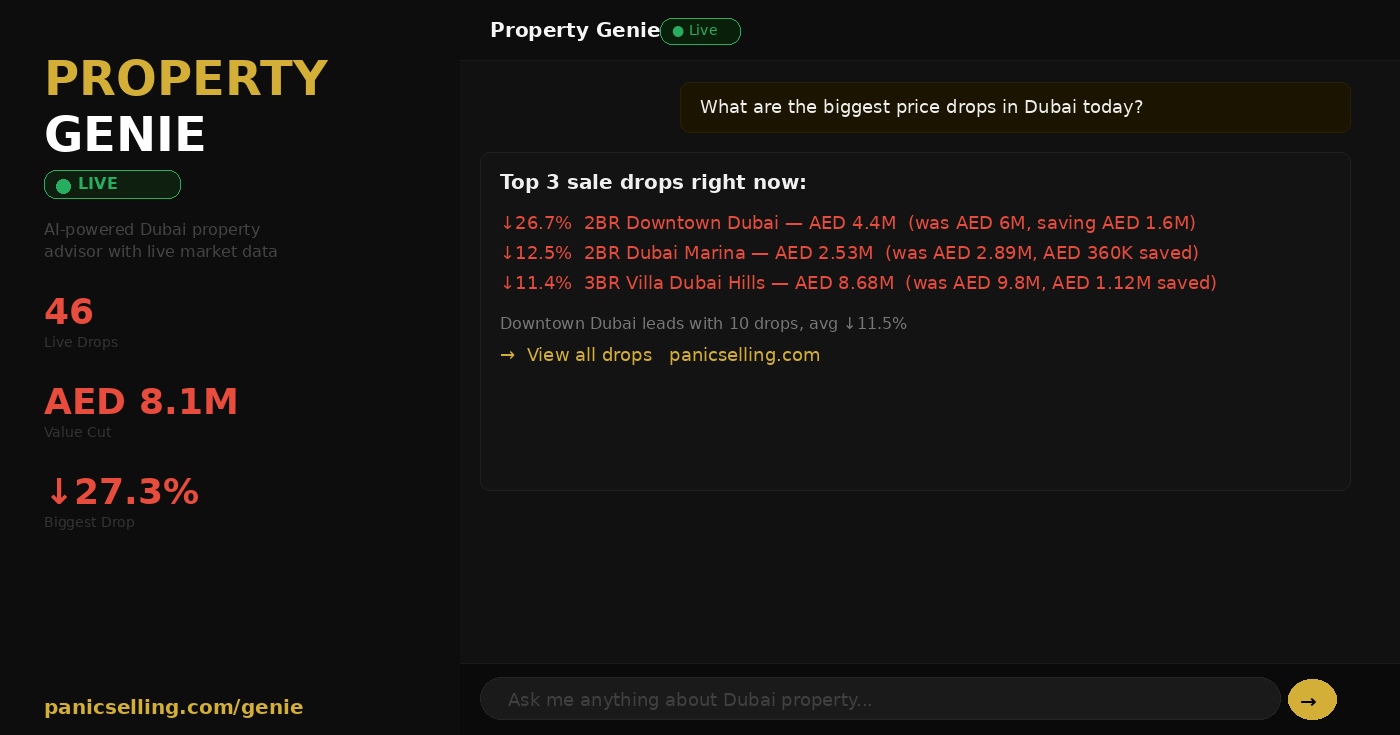
A visitor to panicselling.com can now type any property question and receive an instant, data-backed answer. Ask “What are the biggest price drops today?” and Property Genie responds with the actual top drops — property type, area, original price, current price and AED saved — pulled from the live database in real time.

The advisor is trained on Dubai-specific knowledge: 0% capital gains tax, freehold ownership rules, Golden Visa eligibility thresholds, NRI remittance limits under India’s Liberalised Remittance Scheme (LRS), DLD transfer fees, rental yields by area and RERA regulations.

Built Entirely with AI — Zero Traditional Coding

“I did not write a single line of code manually,” said the founder. “Claude AI and Gemini Enterprise built the entire platform — the backend, the frontend, the data pipeline and now the AI advisor. What would have taken a team of five engineers six months, I did alone in 40 hours.”

The platform now tracks price drops across Dubai, Abu Dhabi, London, Florida and Toronto — with a live Panic Index (0–99 score) measuring seller distress daily across all five markets.

Traction in Under One Month

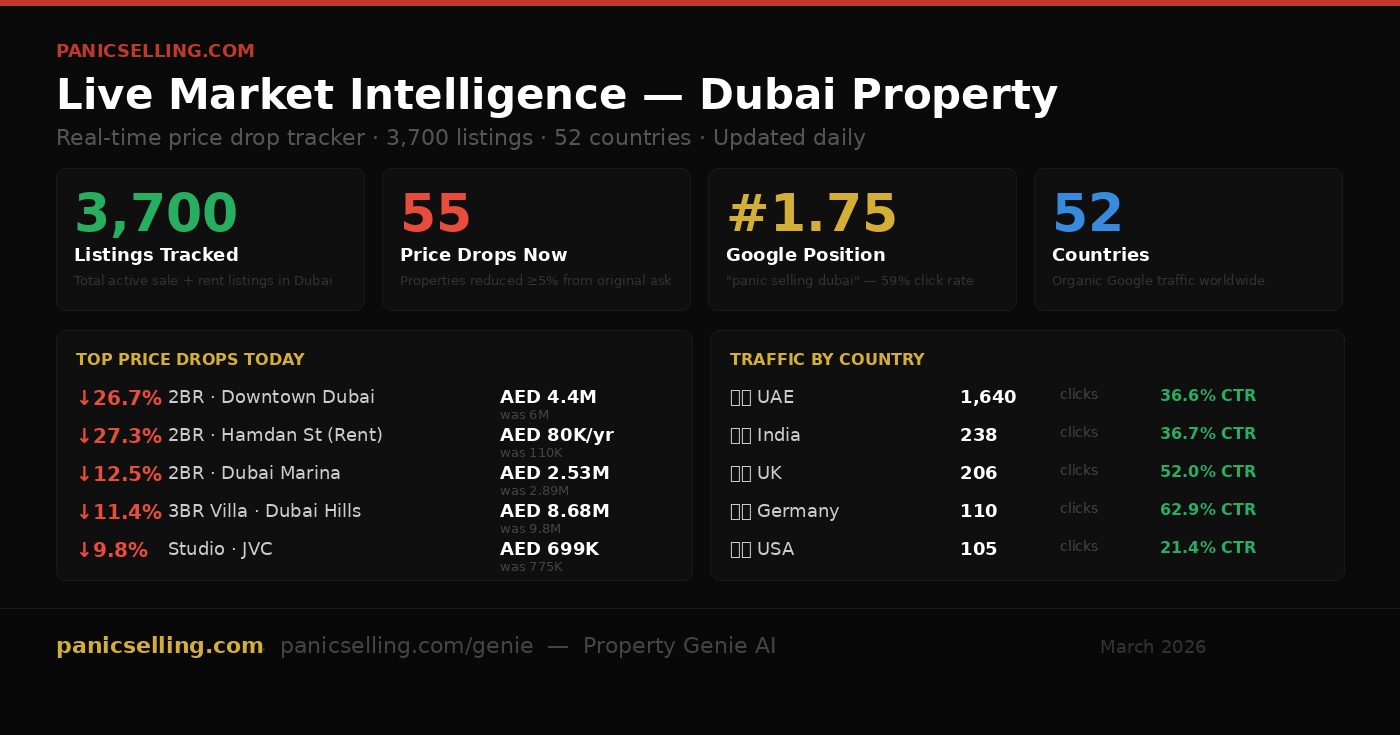
  • Ranked organically on Google across 52 countries
  • Over 3,000 clicks in 7 days — 59% click-through rate on primary keyword
  • Indexed across 158 pages within 28 days of launch
  • Property Genie indexed by Google within 5 hours of launch
  • Featured broker revenue pipeline established — AED 999/month per slot across 5 markets

Why This Matters for NRI and International Buyers

India is the largest source of foreign property buyers in Dubai, with NRIs investing billions annually in UAE real estate. Yet no platform has given NRI buyers a data intelligence layer — until now.

PanicSelling.com surfaces listings where sellers have already reduced their asking price by 5% or more, giving buyers a negotiation starting point that was previously invisible. Property Genie adds a conversational layer — buyers can now ask about LRS remittance limits, Golden Visa thresholds, DLD costs and negotiation tactics in plain language, and receive answers backed by live market data.

About PanicSelling.com

PanicSelling.com is a real-time property price drop tracker and market sentiment index covering Dubai, Abu Dhabi, London, Florida and Toronto. The platform tracks over 3,600 Dubai listings daily, detecting price reductions and calculating a proprietary Panic Index score. Free to use. Updated daily.

Website: https://panicselling.com

Property Genie: https://panicselling.com/genie

Contact: contact@panicselling.com

In the rapidly evolving financial services industry, trust and credibility are essential pillars that define long-term success. However, in a competitive environment, it is not uncommon for misinformation to circulate through unofficial articles or statements intended to create confusion among investors and clients.

Recently, certain competitors have attempted to label our organization as fraudulent by publishing misleading articles and unverified claims. Such allegations are not only inaccurate but also represent an unfortunate tactic sometimes used in highly competitive markets to damage the reputation of legitimate businesses.

Our organization operates with a clear focus on professionalism, transparency, and ethical business practices. We work closely with SEBI-registered trading platforms and recognized financial infrastructures, ensuring that our clients interact with systems that follow industry standards and regulatory frameworks.

It is also important to clarify the nature of our operations. Our company primarily functions as a Forex Broking and Financial Services provider. In many business structures within the forex brokerage ecosystem, companies act as intermediaries that connect clients to international trading platforms or liquidity providers. In such cases, a direct SEBI registration for the company itself may not always be required, depending on the service structure and jurisdiction. Nevertheless, we remain committed to operating responsibly and maintaining high standards of compliance and transparency in all our activities.

Unfortunately, misinformation published without proper verification can create unnecessary doubt among investors. We strongly encourage clients and the public to rely only on verified information, official announcements, and credible sources when evaluating financial service providers.

Our reputation has been built through consistent service, professional conduct, and long-term relationships with our clients. Rather than engaging in negative competition, we believe in focusing on what truly matters—delivering reliable brokerage services, maintaining transparency, and helping investors access global financial markets responsibly.

As the financial industry continues to grow, maintaining integrity and trust will remain our highest priorities. We remain committed to providing safe, transparent, and professional brokerage services while continuing to strengthen confidence among our clients and partners.

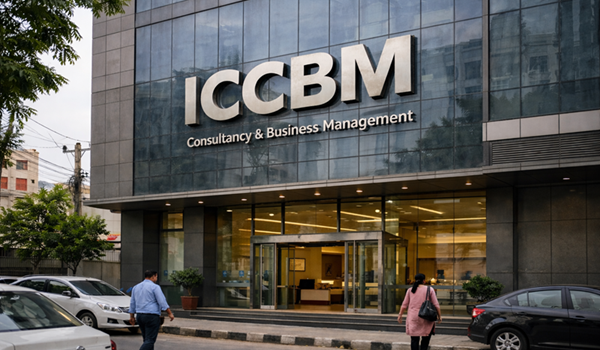
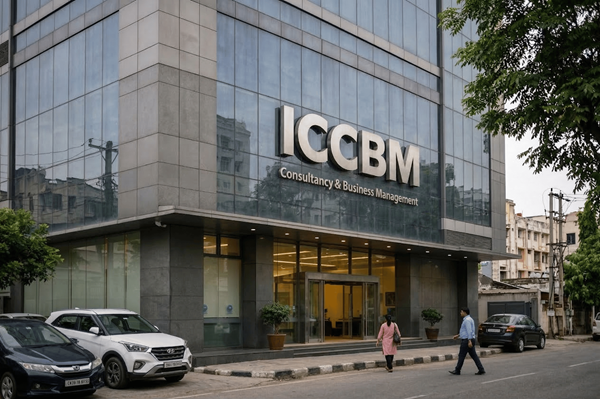
New Delhi, India: India’s small and mid-sized enterprises (SMEs) form a major pillar of the country’s economic growth. However, many growing businesses encounter operational challenges as they attempt to scale beyond their early stages. Industry observers have frequently pointed to the lack of structured operational systems, governance frameworks, and integrated digital infrastructure as key factors that limit long-term scalability for emerging companies.

Against this backdrop, ICCBM has announced the launch of an advisory platform designed to help Indian SMEs build structured business systems that support sustainable growth and operational stability.

The platform focuses on assisting businesses in developing integrated frameworks across multiple domains, including operational management, digital infrastructure, governance structures, reporting systems, and organizational processes. The objective is to help organizations transition from informal operational models toward structured systems capable of supporting larger and more complex business environments.

According to Subodh Kaushik, Managing Director of ICCBM, many growing companies encounter structural limitations as they expand, particularly when operational systems fail to evolve alongside business growth.

“A significant number of businesses in the SME segment demonstrate strong market potential, but operational complexity often increases as organizations scale. Establishing structured systems early can significantly improve decision-making, operational efficiency, and long-term sustainability,” Kaushik said.

The ICCBM advisory platform is intended to support companies that are entering phases of expansion and require structured frameworks to manage growth effectively. The company’s approach focuses on building operational systems that integrate technology, governance processes, and organizational workflows.

Industry observers note that Indian SMEs are increasingly seeking structured advisory support as competition intensifies and businesses adopt more technology-driven operational models. Platforms such as ICCBM’s consulting initiatives aim to address this need by helping organizations design scalable operational foundations.

ICCBM plans to work with companies across multiple sectors, particularly organizations seeking to modernize operational structures, strengthen digital infrastructure, and implement more effective governance and reporting frameworks.

As part of its early expansion strategy, the company also plans to introduce strategic service discounts for select clients, enabling a broader range of SMEs to access structured advisory support during critical growth phases.

Kaushik noted that demand for structured advisory services is expected to grow as companies increasingly recognize the importance of building strong internal systems.

“We believe many businesses are entering a stage where structured advisory support becomes essential for sustainable expansion. Our objective is to work closely with organizations to help them build systems capable of supporting long-term growth,” he added.

According to projections shared by the company, ICCBM aims to achieve approximately ₹250 crore in cumulative advisory engagements by mid-2027, reflecting the anticipated growth in demand for structured operational, governance, and digital advisory services among Indian enterprises.

As businesses across India continue to expand and adopt more sophisticated operational models, advisory platforms focused on structured business systems are expected to play a growing role in helping organizations achieve sustainable and scalable growth.

Further information about ICCBM and its advisory initiatives is available at https://iccbm.in.

GURUGRAM, India: Manoj Madhusudanan’s debut short film, Random Beats, has been awarded Best Short Film at the recently concluded Mei International Film Festival 2026, further cementing its standing as one of the notable independent short films to emerge on the festival circuit in recent years.

The latest honour follows a string of recognitions for the film, including the Best Debut Award at the Aravali International Film Festival. Random Beats has also drawn attention at festivals such as the International Film Festival of Shimla, Atlanta Indian Film Festival, India International Film Festival of Boston, and the 7th South Asian Film Festival, among others.

Written, produced, and directed by Madhusudanan, the film is a quietly observed meditation on the ways digital communication shapes contemporary relationships. At a time when human interaction is increasingly mediated by screens, Random Beats explores the subtle fractures, misread intentions, and emotional dissonance that can arise from virtual exchanges.

“We live in a world where we often communicate more through digital channels than in person, and that creates countless possibilities for friction and miscommunication,” said Madhusudanan. “A real-life incident narrated to me became the seed for this story. I wanted to tell it because it felt simple, relatable, and yet deeply thought-provoking.”

Madhusudanan brings to filmmaking an unusual professional trajectory. Based in India, he is a Leadership Presence and Storytelling Coach with over 25 years of corporate experience spanning data analytics, consulting, and AI. Educated at IIT Madras and XLRI Jamshedpur, he has pursued cinema as a parallel passion since childhood.

Drawing inspiration from masters such as Ingmar Bergman, Steven Spielberg, Majid Majidi, Werner Herzog, Satyajit Ray, and Adoor Gopalakrishnan, he deepened his engagement with the craft through three film certification programmes at Raindance Film School, London, completed between 2015 and 2016. After several amateur experiments, Random Beats marked his first professionally mounted work.

Reflecting on the film’s formal choices, Madhusudanan said, “To tell this story without distraction, I chose a linear narrative structure, a contemporary pastel palette, and a minimalist use of background score. It is truly heartening to see the appreciation and accolades our little film is receiving at international film festivals.”

With this latest recognition, Random Beats has now been selected at 22 prestigious national and international film festivals, winning honours at eight of them.

About the Film

Random Beats is a short film written, produced, and directed by Manoj Madhusudanan. The film examines how digital communication influences personal relationships and the subtle ways in which modern modes of interaction can lead to misunderstanding and emotional complexity.

About Manoj Madhusudanan

Manoj Madhusudanan is a Leadership Presence and Storytelling Coach based in India, with over 25 years of experience in the corporate world. With academic credentials from IIT Madras and XLRI Jamshedpur, and filmmaking certifications from Raindance Film School, London, Manoj brings together analytical depth, storytelling insight, and cinematic passion in his creative work.

Bootstrapped initiative delivers markets, news and panchang updates every morning at 7:30 AM, helping users step out informed in under two minutes

Mumbai: In a country where mornings often begin with a flood of messages, notifications and multiple apps competing for attention, Mumbai-based entrepreneur Sunny Kothari has launched Ghoshna, a WhatsApp-first morning briefing designed to bring clarity and structure to the start of the day.

Delivered directly on WhatsApp every morning at 7:30 AM, Ghoshna provides a concise snapshot of essential updates including market movements, key news headlines and the day’s panchang, all in a format designed to be read in under two minutes.

The idea for Ghoshna emerged from observing how millions of Indians start their day.

“For many people, the first 30 minutes or more, of the morning are spent switching between WhatsApp messages, news apps, market websites and forwards just to understand what’s happening,” says founder Sunny Kothari. “That process can be distracting and overwhelming. Ghoshna was created to simplify that moment.”

Instead of requiring users to download another app, the service works entirely through WhatsApp, delivering a structured morning update directly where many people already begin their day.

Each daily briefing includes:

  • A snapshot of Indian and global markets including Gift Nifty, Nifty, Sensex and major international indices and commodities
  • A quick overview of the day’s key news headlines
  • Panchang details including tithi, rahu kaal and shubh muhurat
  • A shareable good morning image personalized with the user’s name

Beyond convenience, the service is also shaped by growing awareness around the impact of Information overload early in the morning.

Several studies have highlighted that excessive digital stimulation immediately after waking can trigger cortisol spikes, the body’s primary stress hormone. This can contribute to increased anxiety, elevated blood pressure and mental fatigue, particularly when people spend extended periods — sometimes more than 30 minutes — navigating fragmented information across different platforms.

Ghoshna attempts to address this by offering a calm and structured update rather than a constant stream of notifications.

“The idea is not to add more information,” Kothari explains. “It’s to help people access the important updates quickly so they can start their day with clarity.”

The initiative has been developed as a bootstrapped effort, with a focus on gradually building a reliable service before expanding further.

Within the first month of launch, Ghoshna has already attracted over 1,000 early users, many of whom have adopted the service as part of their morning routine.

The platform is currently available free during its early access phase, allowing users to try the service and provide feedback as the product continues to evolve.

Kothari says additional features are already in development. Upcoming updates are expected to include cricket and IPL match updates, along with other contextual information that people often check during the morning.

“As the service grows, the aim is to keep adding useful elements while maintaining the simplicity of the experience,” he says.

The broader vision for Ghoshna is to build a trusted daily habit — one that fits naturally into the routines people already follow.

“Mornings set the tone for the rest of the day,” Kothari adds. “If we can help people start that moment feeling informed instead of overwhelmed, that’s a meaningful step.”

As digital consumption habits continue to evolve in India, services built around existing platforms and familiar behaviours are increasingly gaining traction.

Ghoshna reflects that shift by meeting users where they already are — inside WhatsApp — rather than asking them to adopt yet another platform.

About Ghoshna

Ghoshna is a WhatsApp-first morning briefing founded by Mumbai entrepreneur Sunny Kothari. Delivered every morning at 7:30 AM, the service provides a concise snapshot of markets, news and the day’s panchang, helping users step out informed in under two minutes.

The service is currently available in early access and trusted by more than 1,000 users within its first month.

For more information, visit www.ghoshna.in, or say “Hi” on WhatsApp at +91 8000100898.

Users can also join directly by clicking: https://wa.me/918000100898?text=Hi!%20My%20friend%20recommended%20ghoshna.%2 0Referral%3A%20online

New Delhi [India], March 13: In just one month, Atomesus AI has crossed 1.1 million active users, with the same number of new users joining the platform within the same period. For a young AI platform still expanding its ecosystem, that kind of growth isn’t just impressive — it’s a signal that something meaningful is happening.

Behind the scenes, the data reveals more than just sign-ups. It shows behaviour. Engagement. Curiosity. People actually using the product.

And that’s where the real story begins.

A Million Users — and They’re Not Just Visiting

According to the latest analytics snapshot from the platform’s dashboard:

  • Active users: 1.1 million
  • New users: 1.1 million
  • Average engagement time: 7 minutes 11 seconds
  • Total events recorded: 7.5 million

An average engagement time of over seven minutes is particularly notable in the AI product space. Many platforms struggle to hold attention for even half that time.

Seven minutes means users are not just opening the app out of curiosity.

They are interacting, testing features, asking questions, studying, and exploring AI workflows.

In other words, this is usage — not just traffic.

The Page That’s Driving the Surge

The main Atomesus platform page alone generated:

  • 3.1 million views
  • 1 million active users
  • 7 million recorded interactions

Even more interesting is the bounce rate of just 21.8% on the main product page.

For context, most technology platforms see bounce rates between 40-60%.

Dropping below 25% suggests users are sticking around and moving deeper into the product, rather than leaving after a quick glance.

That kind of engagement usually happens when users quickly understand what a product does — and want to try it.

Login Activity Shows Strong Returning Usage

Another important signal appears in the login data.

The Login page recorded over 130,000 views with a bounce rate of just 2.9%, meaning nearly everyone who lands there continues into the product.

Low bounce on login pages is a classic indicator of returning users, not one-time visitors.

In short:

People are coming back.

And they’re doing it consistently.

The Growth Engine: Curiosity Around AI Learning

A big portion of the platform’s interaction appears to be centred around AI-assisted learning, study tools, and exam preparation.

The analytics dashboard also highlights traffic to pages connected with sign-ups and learning features, including:

  • Sign-up flows
  • Teacher dashboard tools
  • AI learning interfaces
  • Educational exploration pages

With over 7.5 million recorded events in a single month, users are clearly interacting with features — clicking, generating responses, navigating tools, and experimenting with AI capabilities.

This suggests the platform is evolving into more than a chatbot.

It’s becoming a daily-use AI workspace for students and knowledge workers.

Early Signals of Product-Market Fit

Startups often chase a single metric: product-market fit.

It’s the moment when users don’t just try a product — they start depending on it.

The early analytics from Atomesus hint that the platform may be approaching that stage.

Three signals stand out:

1. Rapid user acquisition

1.1 million users in a month is not organic drift. It suggests strong word-of-mouth and curiosity.

2. Deep engagement

A 7-minute average session means users are actually spending time interacting with the system.

High feature interaction

7.5 million events indicate the product isn’t static — people are actively exploring its capabilities.

Together, these signals point toward a platform that is starting to stick.

A Bigger Story: India’s AI Wave

The rise of Atomesus also fits into a broader trend.

India is currently witnessing an explosion of AI adoption across students, developers, creators, and startups. With millions of new internet users entering the digital economy each year, demand for accessible AI tools built for local users is rising rapidly.

Platforms that combine learning, productivity, and AI assistance are positioned to benefit from this shift.

Atomesus appears to be tapping directly into that wave.

What Comes Next

The real challenge begins after the first million users.

The next phase for the platform will likely focus on:

  • Expanding AI capabilities
  • Improving learning and productivity tools
  • Increasing retention and daily active usage
  • Building a larger ecosystem around the platform

If the current trajectory continues, the next milestone could arrive quickly.

Because in the AI world, growth doesn’t usually move in straight lines.

It moves in explosions.

And right now, the numbers suggest that Atomesus may just be getting started.

Visit: www.atomesus.com